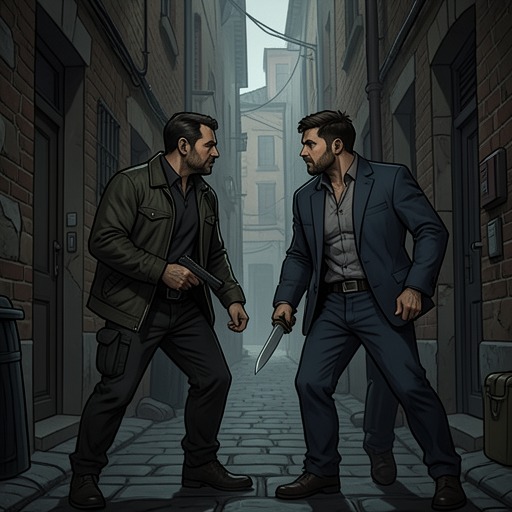
Krissy's gun
Hayden's TimbreKrissy's gun is the decisive instrument of the armed confrontation at the Powell family home. It is not merely a firearm brought into the scene as a threat; it is the physical expression of Krissy's attempt to impose a biological claim on Crew Devillier through terror. Once displayed, the household's ordinary arguments about family and belonging become a life-and-death struggle in which Hayden Devillier must protect Crew, Ryan Powell shields Peri Powell, and every movement is measured against the possibility of gunfire.
Appearance and Immediate Function
Krissy and Ella arrive knowing that the people in the house will resist them. Krissy states that they brought the gun precisely because they expected trouble and believes that its presence gives them control. Her stated objective is to force Crew to sit beside her so that she can begin knowing her son, but the weapon makes the demand inseparable from coercion. It is pointed into the room even when lowered toward the floor, preserving the threat while allowing Krissy to present herself as the person directing the encounter.
The gun also reorganizes the positions of everyone around it. When Krissy orders Crew to come to her, Hayden places himself between them and refuses to let Krissy frighten a child who does not know her. Ryan immediately moves Peri behind him and tells Krissy that there is no need for a gun. His response identifies the weapon's real function: it is not required for conversation, recognition, or reconciliation, but for forcing compliance when those possibilities fail. Krissy's insistence that she holds all the cards makes the firearm a symbol of power built on intimidation rather than parental trust.
The Armed Standoff
The gun intensifies the scene while Hayden tries to keep Krissy talking. Krissy rejects his attempt to control the conversation, summons Ella closer, and continues speaking about Crew's resemblance to her while retaining the weapon as a constant danger. The contrast is deliberately stark: she invokes motherhood and childhood beauty while using an armed threat to demand access to a son who has never known her. The gun therefore exposes the contradiction between biological connection and earned family relationship.
The weapon's threat is directed at more than Hayden. Earlier, Krissy and Ella had used the possibility of violence against Crew to compel Timbre Simons to leave Austin and Texas. In the household confrontation, Krissy again treats Crew as the object through which other adults can be controlled, demanding that Hayden bring him close while declaring that he will never leave her sight. The gun gives that demand immediate force, but it cannot create affection or legitimacy. Instead, it confirms that Krissy's effort to reclaim family operates through captivity, surveillance, and fear.
Intervention and Consequences
The standoff breaks when a loud boom comes from the back door and several men in black clothing rush into the room. Hayden immediately covers Crew with his body, choosing to absorb any bullets rather than let the child be exposed. In the ensuing struggle, Ella is shot in the shoulder and falls with blood spreading across the floor. Hayden keeps Crew from seeing her body, while Ryan throws a cover over Ella long enough for Hayden to remove Crew from the room.
The firearm's appearance thus produces the opposite of the reunion Krissy claims to want. Rather than bringing mother and son together, it turns the household into a tactical emergency and makes Crew a witness to the consequences of adult violence. The SWAT team takes Krissy into handcuffs, and Ella is transported by ambulance. By the time the police leave, Krissy has not secured access to Crew; she faces a long period in jail, while the danger attached to the gun has become evidence against her and Ella.
Narrative and Thematic Significance
Krissy's gun belongs to a recurring pattern in the story in which danger is associated with forced movement and the destruction of personal choice. Hayden's anger over Timbre riding a bus alone reflects a protective, though verbally aggressive, fear of unseen violence. Krissy and Ella transform that fear into deliberate control: they drug and seize Timbre, threaten Crew, force Timbre onto a bus, and later enter the family home armed. The contrast distinguishes protection intended to preserve another person's safety from coercion that claims to act for family while removing autonomy.
The gun also makes visible the difference between biological parenthood and parental responsibility. Krissy calls Crew her son and demands recognition, but Hayden is the person who places his body over the child, keeps him from seeing the wounded woman, and explains that Krissy will be imprisoned. The weapon cannot settle the question of who has acted as a parent; it only dramatizes how completely Krissy's claim has been separated from care. Its final narrative effect is therefore clarifying rather than conciliatory: the firearm strips away the language of reunion and reveals a struggle over possession, safety, and the right to define family.